
Application:
For closed dry hopping of beer. Suitable for aroma extraction during mid- to late-fermentation or maturation stages. Designed to minimize oxidation and prevent hop debris from entering the fermenter.
Safety Instructions:
Operate under fully closed conditions at all times. Never open the manway under pressure. Use food-grade hoses and ensure CO₂ inert gas protection during operation. Wear impact-resistant safety goggles and acid- and alkali-resistant gloves.
Part 1: Equipment and Material Preparation
1. Equipment Inspection
Main Body:
Ensure the vessel is leak-free, the manway gasket is intact, and the pressure gauge has been calibrated and is within its valid certification period.
Filtration System:
Verify that the internal filter screen / candle-type filter elements are free from blockage or damage and are properly installed in position.
Valves and Connections:
Valves and Connections: Confirm smooth operation of the following ports and valves:
~ Inlet (bottom)
~ Outlet (top)
~ CO₂ purging port (top)
~ Drain port (bottom)
~ Sampling valve
Auxiliary Components:
Ensure food-grade hoses, CIP cleaning circuit, and gas line connections are properly installed and ready for operation.
2. Material Preparation
Hops:
Pellet hops are preferred to reduce the risk of blockage. Weigh according to the brewing recipe. Recommended maximum loading capacity: ≤ 60 kg (200 L × 30% filling ratio).
Gas:
~ Use food-grade CO₂. Set the pressure regulator to 0.1–0.2 MPa.
~ Cleaning
Prepare CIP cleaning solution for pre-operation sanitation.
Part 2: Operating Procedure
Stage 1: CIP Cleaning and Sterilization
1. Remove the filter element and clean it separately. Close all valves and open the gas valve ⑤ to prevent negative pressure damage to the vessel. Connect the CIP tank to the Hop Gun inlet (If the CIP system has a supply pump, connect to CIP port ②. If no supply pump is available, connect to pump inlet ①. Connect the outlet back to the CIP pump ③.
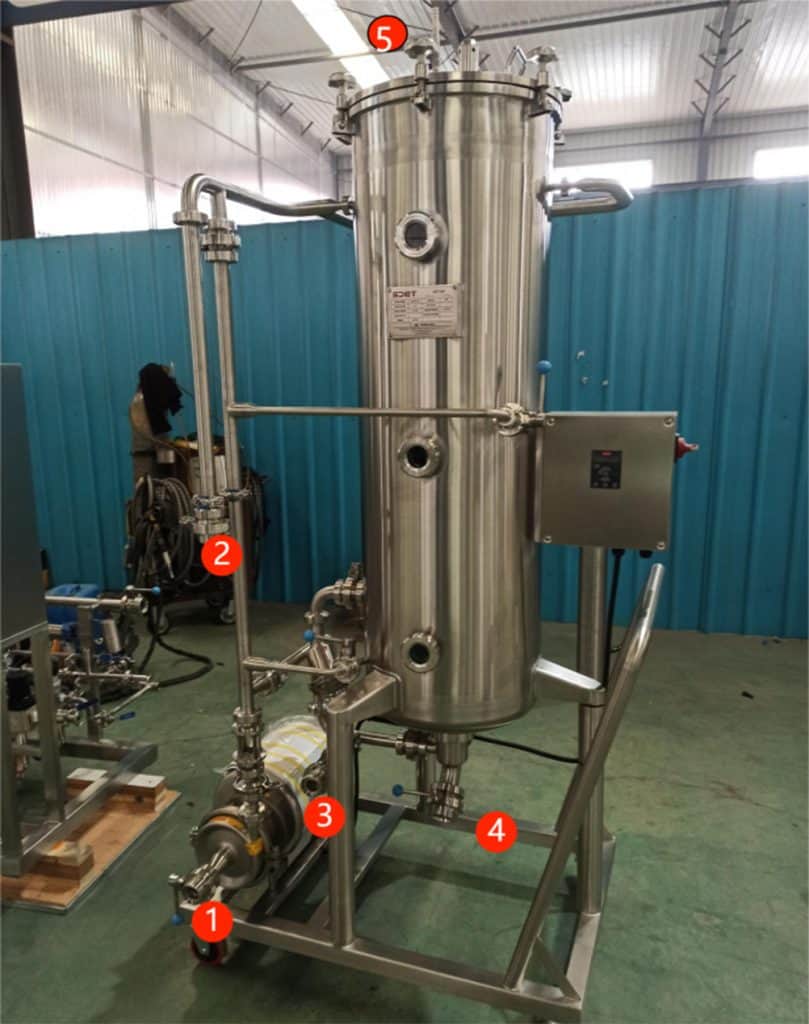
2. Start the CIP pump and perform cleaning in the following sequence:
~ Rinse with clean water (5–10 min)
~ Alkaline cleaning (50–60°C, 15–20 min)
~ Rinse with clean water (until neutral)
~ Reinstall the filter element
~ Acid cleaning (20–30 min)
~ Rinse with clean water (until neutral)
~ Final sanitizing rinse (5 min)
During cleaning, open the pipeline valves in sequence to create different circulation loops and ensure all internal pipelines are thoroughly cleaned.
3. After cleaning is completed, open the drain valve ④ to discharge residual liquid. Close the gas valve ⑤, keep the vessel clean and ready for use.
Stage 2: Inert Gas Purging
1. Connect the CO₂ gas line to the bottom drain port. Ensure all internal pipeline valves of the Hop Gun are open. Open the top gas valve and the bottom drain valve. Introduce CO₂ and purge for 5–10 minutes to remove air from the vessel.
2. Maintain a minimal CO₂ flow and prepare for hop loading.
Stage 3: Hop Loading
1. Confirm the gas valve is open and ensure there is no high pressure inside the vessel. Slowly open the manway.
2. Quickly load the pre-weighed hops into the vessel. Prevent hop material from remaining on the manway sealing gasket.
3. Close and secure the manway. Reopen CO₂ purging for 2 minutes to remove any air introduced during loading.
Stage 4: System Connection and Circulation Extraction
1. Pipeline Connection
~ Fermenter beer outlet → Centrifugal pump inlet
~ Hop Gun top gas valve → Fermenter L-pipe
~ Hop Gun beer outlet → Fermenter return inlet
~ Keep all valves closed
2. Liquid Filling
~ Open the Hop Gun top gas valve, fermenter outlet valve, and centrifugal pump inlet valve. As the liquid level rises, gradually adjust butterfly valves ① and ②. Start the centrifugal pump to allow beer to enter the vessel from the bottom.
~ When the liquid level rises and flow rate slows, operate the centrifugal pump accordingly.
~ When the liquid reaches the upper sight glass ③:
— Close the top gas valve
— Close the fermenter inlet valve
— Connect the pump inlet to the Hop Gun outlet
— Open valve ④ to form a self-circulation
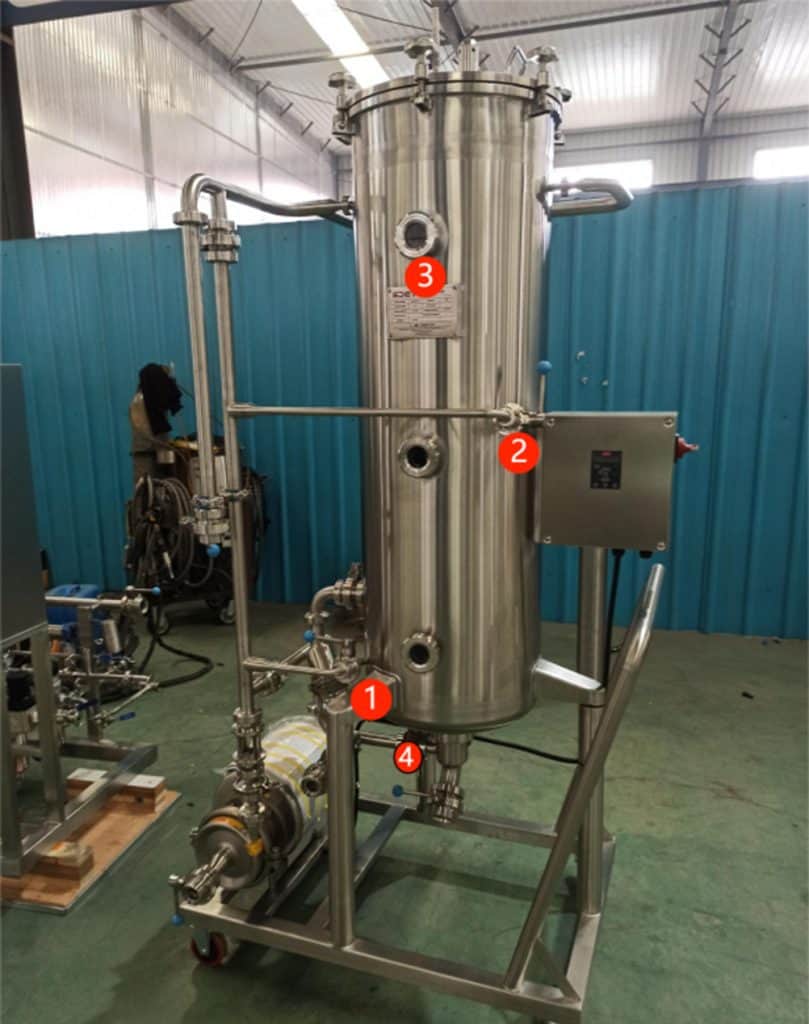
3. Circulation Extraction
~ Gradually adjust the pump flow rate to create turbulent flow inside the vessel and prevent filter blockage.
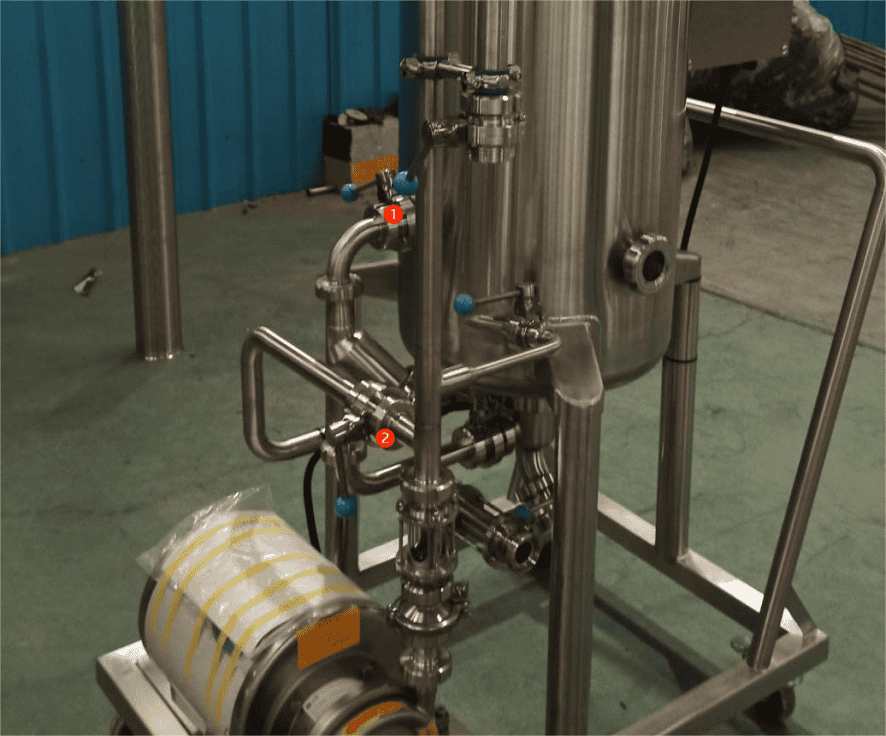
~ Observe hop density through the sight glass. Adjust the upper and lower whirlpool ports as needed to ensure thorough mixing of beer and hops.
~ If turbulence weakens:
–Temporarily stop the pump and close all valves
–Open valves ① and ②
–Restart the pump to create a reverse-flush loop
–After filter blockage is cleared, stop the pump and close the valves
–Restore the original circulation configuration
Stage 5: End of Extraction and Residual Liquid Recovery
1. Stop the pump and close all valves. Connect the Hop Gun outlet back to the fermenter.
2. Connect the CO₂ gas line to the gas valve and open it. Slowly pressurize the vessel with CO₂ to push residual liquid back into the fermenter. (Maintain stable pressure to prevent backflow.)
3. Observe through the sight glass. After all beer has been recovered, close all valves.
Stage 6: Hop Residue Removal and Equipment Reset
1. Open the bottom drain valve. After confirming there is no pressure inside the vessel, open the manway and remove hop residues.
2. Disassemble the filter screen / pipeline filter element. Rinse thoroughly with clean water to remove hop residues. Use a soft brush if necessary (steel wool is strictly prohibited).
3. Reinstall the filter elements. Perform CIP cleaning (same procedure as Stage 1). After completion, drain completely and store dry.
Part 3: Troubleshooting
| Fault Phenomenon | Possible Cause | Corrective Action |
| Pump flow decreases / Pressure increases | Filter screen blockage | Stop operation immediately. Perform CO₂ backflushing. If ineffective, disassemble and clean the filter screen. |
| Insufficient aroma extraction | Flow rate too low / Improper temperature / Insufficient extraction time | Increase pump flow rate to achieve turbulent flow. Adjust temperature to 18–20°C. Extend extraction time. |
| Beer oxidation (cardboard off-flavor) | Incomplete purging / Seal leakage | Check CO₂ purity and purging duration. Replace manway gasket and repair leakage points. |
| Hop residue entering fermenter | Damaged filter screen / Overloading | Stop operation and replace the filter screen. Strictly control hop loading capacity. |
Part 4: Maintenance
1. Daily Maintenance: CIP cleaning must be performed after each use to prevent hop residue accumulation and bacterial growth.
2. Weekly Inspection: Check valve seals and pressure gauge accuracy. Clean impurities from the filter screen.
Part 5: Critical Precautions
1. No Operation Under Pressure:
All opening and disassembly operations must be performed only when the pressure gauge reads 0.
2. Inert Gas Protection:
From hop loading to the end of extraction, maintain a minimal continuous CO₂ flow to prevent air contact.
3. Pump Selection:
A sanitary diaphragm pump is recommended. Avoid excessive shear from centrifugal pumps, which may increase hop debris generation.
4. Hop Type Consideration:
When using whole-cone hops, increase the filter mesh size and reduce the loading capacity by 50% to prevent severe blockage.
The 200L hop gun provides an efficient and controlled solution for closed dry hopping, enabling brewers to maximize aroma extraction while minimizing oxidation and product loss. Through proper CIP cleaning, CO₂ purging, and controlled circulation, the system ensures both product quality and operational safety. By following standardized procedures and maintenance practices, brewers can achieve consistent flavor results, extend equipment lifespan, and maintain hygienic production conditions. This makes the hop gun an essential tool for breweries aiming to enhance hop character with precision and reliability.


