As craft breweries and commercial breweries continue to grow, kegs have become more than just containers for beer. They are an important part of the overall beer production, storage, and distribution process.
For small breweries, single-head or double-head keg washing and filling machines can often meet daily production needs. However, as the number of kegs in circulation increases, manual operation and equipment capacity can gradually become bottlenecks in the production process.
This is why more commercial breweries are starting to consider four-head keg processing equipment.
Moving from one or two heads to four heads is not simply about adding more working stations. Higher processing capacity, a more complete cleaning process, more precise automatic control, and more flexible filling methods can all become important as a brewery moves toward larger-scale production.
In a recent brewery project, the customer was looking for both a four-head keg washer and a four-head keg filler. After discussing the actual production requirements and filling process, we finally provided a four-head, three-tank keg washer together with a four-head inverted keg filler.
This project also showed us an important point: the right keg equipment should be selected based on the actual production process, not simply on the number of heads.
Part 1: 4-Head Keg Washer — From Higher Capacity to a Complete Keg Processing Process
1.1 Four Heads for Higher Keg Processing Capacity
For a commercial brewery, keg cleaning is not simply about rinsing the inside of a keg.
Before a reusable keg is filled with beer again, it needs to go through a consistent and repeatable cleaning and treatment process.
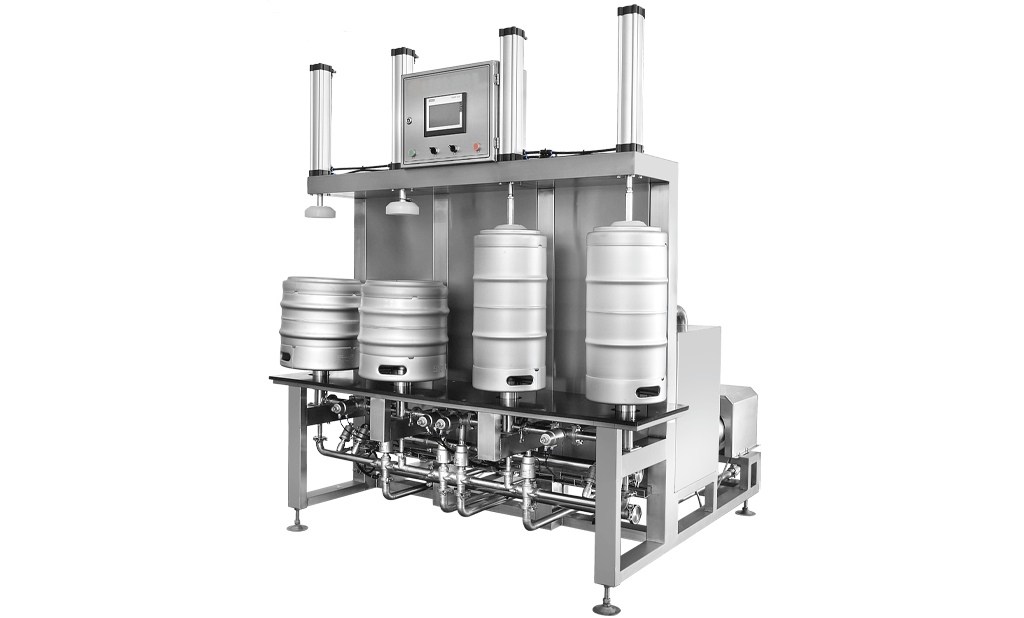
SDET’s 4 Heads Keg Washer with 3 Tanks is designed with four working stations and can process approximately 100–120 kegs per hour. It is suitable for different keg sizes, with a diameter of 250–500 mm and a height of 360–600 mm.
Compared with single-head or double-head equipment, the four-head design allows multiple kegs to be processed at the same time, improving the overall processing capacity per hour.
This makes it a practical choice for commercial breweries with a higher volume of keg turnover.
However, the value of a four-head keg washer is not only its capacity.
For commercial production, it is equally important to maintain a stable and consistent cleaning process for every keg.
1.2 Three Tanks for a Complete Cleaning and Sterilization Process
The three-tank design integrates multiple stages of keg treatment into one automated process, including water washing, caustic cleaning, hot water rinsing, acid cleaning, steam sterilization, and CO₂ replacement.
A typical process can be summarized as:
Residual beer removal and pre-rinsing → Water washing → Caustic cleaning → Hot water rinsing → Acid cleaning → Water rinsing → Steam sterilization → CO₂ replacement → CO₂ blowing → CO₂ pressurization
The process starts by removing residual beer and other contaminants from the keg through air blowing and water washing.
The keg then goes through caustic cleaning to remove organic residues. Hot water rinsing helps remove cleaning solution residues, while acid cleaning can help deal with mineral deposits and scale.
After cleaning, the keg is treated with steam for sterilization. CO₂ is then used to replace the steam and prepare the keg for the next stage.
In other words, a professional keg washer does more than simply “wash” a keg.
It prepares the keg for the next filling cycle with a more controlled and repeatable process.
1.3 Siemens PLC for Stable and Flexible Process Control
A complete keg cleaning process involves multiple steps, so reliable automatic control is essential for commercial production.
The four-head keg washer uses a Siemens PLC to control the entire cleaning process. Cleaning time, temperature, and other process parameters can be set according to the required cleaning procedure.
The main parameters are normally preset at the factory. Once the equipment arrives at the brewery and the necessary piping connections are completed, it can be put into operation.
If the brewery has specific process requirements, operators can also adjust the relevant parameters through the PLC.
The machine can also provide two different cleaning programs for different keg sizes. For example, large and small kegs can use different cleaning times to achieve a more suitable cleaning process for each keg type.
1.4 Reusable Cleaning Solutions and Sensor Monitoring
Resource efficiency and process safety are also important considerations for commercial breweries.
The cleaning solutions can be reused according to the cleaning process, helping reduce water and cleaning solution consumption.
The machine is also equipped with three flow sensors and one pressure sensor to monitor the supply of water, caustic solution, acid solution, and CO₂.
If a required cleaning medium is not available, the system can interrupt the current cleaning cycle instead of continuing to operate without the necessary medium.
These details become particularly important when the machine is processing a large number of kegs every day.
For commercial breweries, reliable automatic control is not only about improving production efficiency. It also helps maintain consistency throughout the keg cleaning process.
Part 2: 4-Head Keg Filler — From Standard Topside-Up Filling to a More Advanced Inverted Solution
2.1 Four-Head Filling for Higher Efficiency
Once the kegs have been cleaned and prepared, the next step is filling.
As with keg washing, choosing a keg filler is not only about production capacity. The filling method, pressure control, beer loss, keg type, and overall filling process can all influence the final equipment selection.
For many commercial breweries, a four-head topside-up keg filler is a simple, efficient, and practical solution.
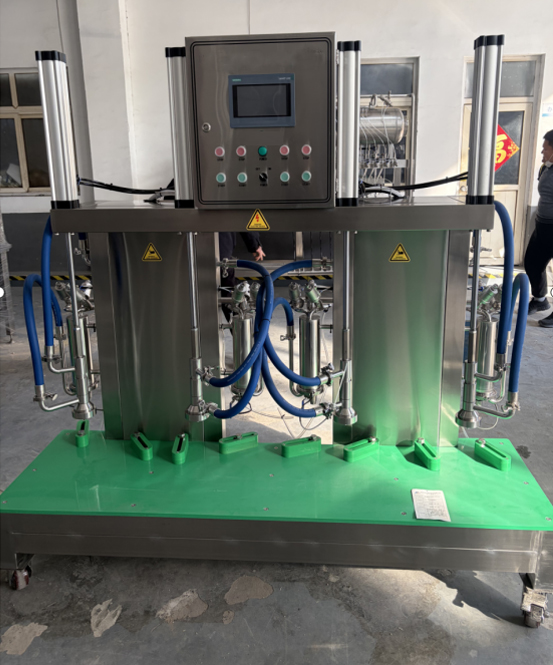
SDET’s 4 Heads Keg Filler is equipped with four independent filling stations and four flow meters. Each filling station has its own control system, with a production capacity of approximately 100–120 kegs per hour.
2.2 4-Head Topside-Up Filling: Simple and Efficient
The standard filling process is relatively straightforward:
Fix the keg → CO₂ pressurization → Beer filling → Stop filling → Remove the keg
This topside-up filling method is simple to operate and highly automated, making it suitable for many commercial breweries with standard keg filling requirements.
The pressure-maintaining system also helps keep the filling pressure stable, which can reduce unnecessary beer loss during filling.
The machine can also fill kegs with different volumes directly without requiring frequent parameter adjustments. This provides additional flexibility for breweries using different keg sizes.
Therefore, when the main goal is to increase keg filling efficiency while maintaining a relatively straightforward filling process, a four-head topside-up keg filler can be a practical solution.
However, not every brewery has the same filling requirements.
2.3 When Topside-Up Filling Is Not Enough: Why Choose Inverted Filling?
In the recent project mentioned above, the customer initially considered a four-head topside-up keg filler.
After discussing the customer’s actual production process and keg handling requirements in more detail, we found that the standard topside-up configuration could not fully meet the customer’s process requirements.
We therefore recommended a four-head inverted keg filling solution.
Compared with the relatively simple topside-up filling process, the inverted solution involves a more complete and more sophisticated keg treatment and filling process.
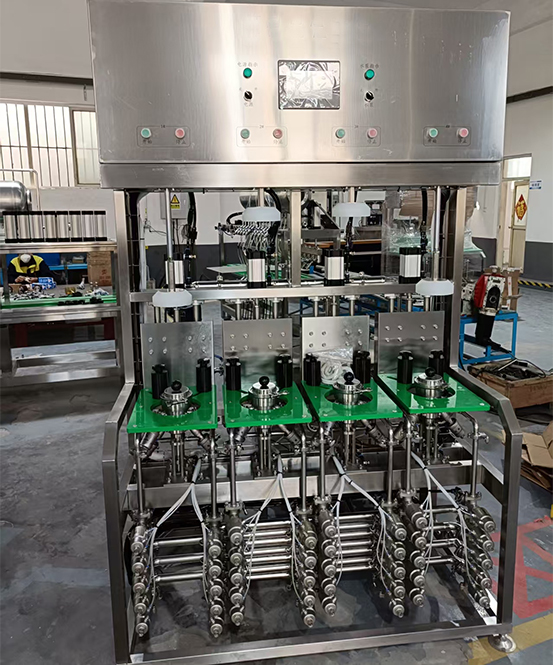
In this configuration, the keg does not simply go through CO₂ pressurization followed by beer filling. Before filling, it can go through a series of controlled processes including caustic cleaning, hot water rinsing, acid cleaning, water rinsing, steam sterilization, CO₂ replacement, CO₂ blowing, and CO₂ pressurization.
The equipment is therefore doing more than simply putting beer into a keg.
It integrates keg cleaning, sterilization, gas replacement, pressurization, and filling into a more complete process.
2.4 Inverted Filling for Higher Process Control
Compared with standard topside-up filling, a four-head inverted solution provides a higher level of control over the overall keg treatment process.
From cleaning and sterilization to CO₂ replacement and pressurization, each stage needs to be completed according to the preset process.
This makes PLC control, flow monitoring, pressure monitoring, and management of different cleaning media important parts of the overall system.
This type of solution can be particularly suitable for commercial breweries with higher requirements for keg cleaning, sterilization, CO₂ replacement, and the condition of the keg before filling.
This is why we do not simply treat topside-up and inverted filling as two different machine configurations.
The actual production process should come first.
If a brewery needs simple and efficient standard keg filling, a four-head topside-up filler can provide good production efficiency and easy operation.
If the brewery has more demanding requirements for keg cleaning, sterilization, CO₂ replacement, and the overall filling process, a four-head inverted solution may be more suitable.
In other words:
Equipment selection should start from the process, not simply from the number of filling heads.
This is also the principle we follow when developing keg processing solutions for our customers.
4-Head Topside Up Filling Machine
4-Head Inverted Filling Machine
Part 3: When Should a Brewery Upgrade from 1–2 Heads to 4 Heads?
For a growing commercial brewery, four-head keg equipment is not simply a “larger version” of a single-head or double-head machine.
When the number of kegs in circulation increases and single-head or double-head equipment starts to become a production bottleneck, four-head equipment can provide higher processing capacity and improve overall production efficiency.
At the same time, as breweries begin to use different keg sizes or require higher standards for cleaning, sterilization, CO₂ replacement, and filling, automation and process control become increasingly important.
Therefore, when considering an upgrade from one or two heads to four heads, breweries should look beyond the number of kegs processed per day.
It is also important to consider the brewery’s current production capacity, keg turnover, keg sizes, cleaning requirements, filling method, and future production plans.
For some breweries, a four-head topside-up filler may be the right choice.
For others, a more advanced four-head inverted solution may be required to meet the actual process requirements.
At SDET, we provide keg washing and filling solutions from single-head and double-head systems to four-head equipment, based on the brewery’s production capacity, keg specifications, cleaning process, and filling requirements.
The goal is not simply to provide a larger machine, but to provide the right equipment for the right production process.